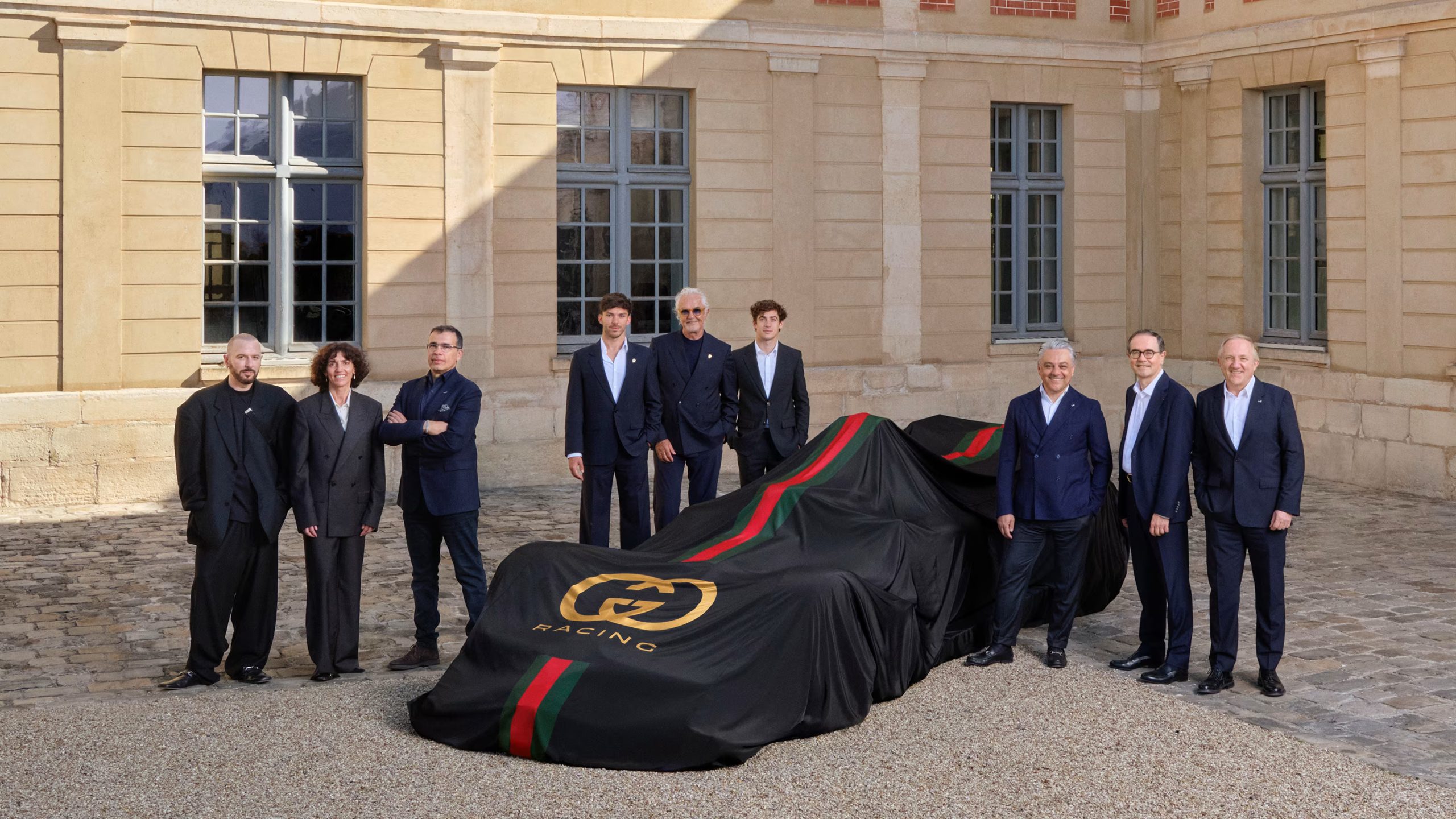
There is a particular kind of announcement that looks, on the surface, like a PR move, but is actually a strategic declaration. Gucci becoming title partner to the Alpine Formula 1 team from 2027 is that sort of announcement.
Read it quickly and you get: fashion brand joins motorsport, team gets new colours, Flavio Briatore says something quotable.
Delve deeper and you get something else entirely. Against the backdrop of Kering’s ongoing turnaround, Gucci’s €6 billion revenue crisis, Demna’s still-forming creative vision, and a luxury market in genuine need of structural recalibration, this move is essentially Gucci using Formula 1 to tell a new story about what it is.
And right now, Gucci needs a new story more urgently than almost any brand in luxury. Which, by all means, shouldn’t be read negatively, as a sign of desperation. But rather as an opportunity to innovate and get a fresh start. And, if I may be so bold as to say, as one of the sexiest brand moves into F1 yet.
The hole Gucci is climbing out of
To understand the Alpine deal, you have to look at the numbers first, because they are stark and pretty telling too.
Gucci has posted ten consecutive quarters of declining sales under parent company Kering. Revenue fell from more than €10 billion in 2022 to around €6 billion in 2025. Kering’s operating margin compressed from 24.3% in 2023 to 14.9% by end of 2024, according to the group’s own annual results. The group’s share price lost more than half its value over two years. Kering, parent company of Saint Laurent, Balenciaga, Bottega Veneta, has Gucci at its centre, and when Gucci falters, the whole thing tilts.
The response from Kering’s then-chairman François-Henri Pinault was as radical as the decline itself. In the summer of 2025, he brought in Luca de Meo, CEO of Renault, credited with nearly doubling that company’s share price and engineering its pivot to EVs, to run a fashion group.
A car executive, to save a fashion house. Unconventional – maybe.
Markets reacted accordingly: Kering surged as much as 10% on the news; Renault’s fell nearly 7%. Once formally in place, de Meo’s first move was to appoint Francesca Bellettini, Kering’s former deputy CEO and the executive who rebuilt Saint Laurent into one of the group’s most consistent performers, as Gucci’s new president and CEO.
Demna Gvasalia, whose appointment as artistic director had been announced in March 2025 after a decade remaking Balenciaga, was already in place.
With the team now set and the turnaround in motion, what was still missing was an act, a move big enough to cut through, to signal to the market that Gucci is in a different chapter.
The Alpine partnership is that act.
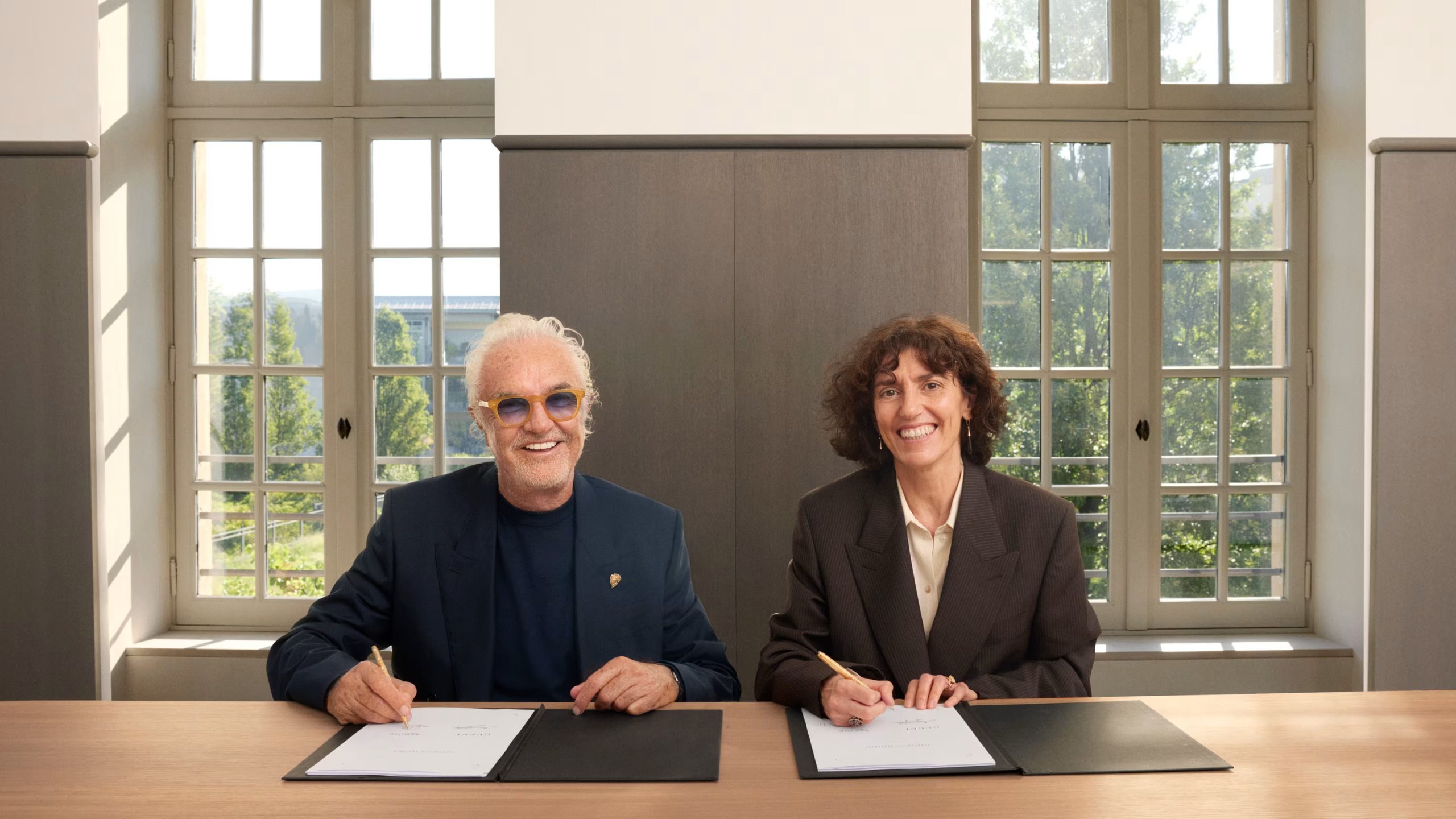
Bellettini, in her announcement statement, said that “Gucci Racing is more than a presence on the grid.”
“It is an expression of who we are and where we want to take the brand,” she said. She is talking about a racing team, whilst describing a mandate at the same time.
What a title partnership actually is
The taxonomy of luxury’s presence in Formula 1 matters here, because no two brand deals are alike.
When LVMH signed its landmark ten-year global partnership with F1 in late 2024 (reportedly valued at up to $150 million a year), it was a very smart portfolio arrangement: Louis Vuitton, Moët Hennessy, and TAG Heuer securing activation rights across the calendar, trophy trunks at grands prix, logo placement, category exclusivity, you name it. A significant, commercially sophisticated, beautifully executed move. But structurally, it is a set of sponsorship activations.
Title sponsorship is a different breed altogether. The brand is not on the team. It is the team. Its name goes into the official entry submitted to the FIA. It lives in every broadcast mention, “the Gucci Racing Alpine Formula One Team”, across a 24-race season in 21 countries. Its colours are on the car that sits in billions of broadcast frames. And ultimately, its identity is woven into the team’s narrative. Gucci Racing is not a campaign you activate at a grand prix weekend. It is an ongoing story, told continuously, whether Gucci is in the room or not.
According to analysis by RtrSports, F1 title sponsorships range from $25 million to $110 million per year depending on team performance and commercial reach. And F1’s overall sponsorship market is projected to exceed $3 billion this year, up 15% year on year, according to industry analysis cited by Ampere Analysis, driven by a commercial platform that generated $3.9 billion in total revenue in 2025, growing 14%.
It is one of the fastest-growing branded properties in the world.
The question now for a brand like Gucci is whether this is the right story to tell. And for a brand trying to reestablish its identity as something urgent, globally relevant, and unapologetically bold, I find it very hard to think of a better one.
The sports strategy Gucci has been building
Now, don’t imagine that the Alpine announcement arrived from nowhere. In the past year, Gucci has been constructing what can now be read as a deliberate sporting universe.
In tennis, the Italian house aligned itself with Jannik Sinner, the ATP World No. 1, as a global ambassador and face of Gucci Altitude, the brand’s first dedicated winter sports line.
Then, at the 2026 Australian Open, came Aryna Sabalenka: reigning world No. 1, 2025 US Open champion, one of sport’s most commercially powerful and media-saturated figures. Her debut Gucci campaign, shot on a tennis court, Sabalenka mid-rally in a long silk twill GG-monogram gown and black heels, was a deliberate provocation. An incredibly stylish one. And one meant to send a very specific message about where Gucci believes those two worlds now sit in relation to each other.
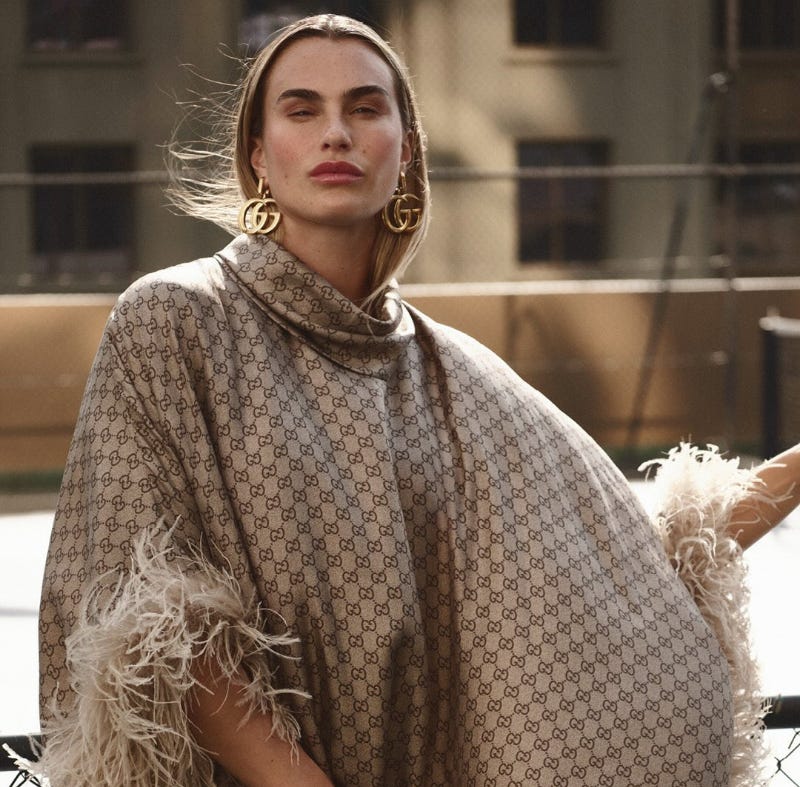
Alpine gives this strategy institutional scale. Individual athlete partnerships produce moments, whether it’s a campaign such as Sabalenka’s, a red carpet appearance, a social post. A title partnership in Formula 1 produces a season: 22 race weekends, constant broadcast presence, global media coverage that generates its own editorial ecosystem entirely independent of Gucci’s marketing budget. The team then becomes a character. Gucci’s name is in its own sentence.
Briatore’s line in the announcement, that “the Enstone team has a history of doing things differently to others, and has previously shown that fashion can finish first in Formula 1”, is deft.
It connects this moment to the Benetton years, to a lineage of identity-first thinking in motorsport. It also shows that in a sport increasingly dominated by engineering and data, identity still drives commercial value. That the teams people feel something about attract partners, audiences, and talent differently from the teams they merely respect.
The Demna factor, and what Gucci Racing means for his project
Demna’s first months at Gucci have been a study in methodical provocation. His debut collection, La Famiglia, dropped as a surprise see-now-buy-now lookbook in December 2025. 37 character-driven portraits, each one a different archetype of “Gucciness,” each one suggesting a brand that wanted to be felt as much as worn.
His first runway show, Primavera, presented at Palazzo delle Scintille during Milan Fashion Week on 27 February 2026, was built around body-first minimalism and Botticelli references, staged in a marble-clad former velodrome lined with Uffizi-replica sculptures.
Demna described his vision in the show statement as being born from months spent in Florence’s archives and at the Uffizi – a creative framework that was, simultaneously, a declaration of belonging and of rupture.
This is the creative register into which Gucci Racing arrives. Performance, precision, discipline, excellence – the language Gucci used to describe Gucci Racing – resembles Demna’s vocabulary, applied to a new arena. A brand that is trying to be both rigorously referenced and viscerally modern; both unmistakably Italian and genuinely global; both romantic and hard-edged. Formula 1, at its best, embodies all of these tensions simultaneously.
What Gucci Racing also gives Demna is something that fashion, alone, cannot provide: a context where performance is literal and measurable. The fashion industry has become sophisticated at the language of craft and quality, but those claims are always, to some degree, soft. The racetrack, by contrast, is not soft. Finishing fifth in the Constructors’ Championship, as Alpine has in 2026, is a fact. The car either performs or it doesn’t. Aligning Gucci’s identity with that kind of verifiable – operational –excellence is far a more interesting brand statement than it might first appear.
The business logic, put simply
De Meo comes from a world where brand architecture is built through product platforms. At Renault, he oversaw the revival of the Alpine brand as an EV marque, a project that was precisely about using identity and heritage to build desire in a competitive market. At SEAT, he created Cupra as a separate, performance-oriented spin-off that unlocked a new consumer segment. His fingerprints are on decisions that treat brand as a strategic asset with operational consequences.
Gucci Racing is not a sub-brand or a product line (yet). But the establishment of Gucci Racing as “a new business and experiential platform”, to use the brand’s own words, opens the door to exactly that. Capsule collections, paddock apparel, the kind of limited-release product that sells on the strength of the moment and the association – a world of commercial opportunity in a nutshell. Gucci has, in effect, created a franchise that did not previously exist, and planted it in one of the most commercially energised spaces in global sport.
The question every luxury house will now be asking – and they will be asking it, because this is the kind of deal that won’t go unnoticed – is whether they are moving fast enough. Kering blinked first. LVMH got to the sport’s title partnership level earlier, but not to the team-title position. The Gucci Racing Alpine Formula One Team, from 2027, is a fact. There is no equivalent at any other house. There is no Chanel Racing. There is no Prada F1 team. There is, right now, a gap.
And Bellettini knows it. “Gucci becomes the first luxury fashion house to serve as title partner in Formula 1,” she said in the announcement. “That reflects our ambition for the brand and the role we want Gucci to play on this stage.”
Whether it works, of course, is a different question. Turnarounds in luxury are slow and expensive, and Gucci has been here before, poised on the edge of a new chapter, waiting for a creative breakthrough. Demna has not yet delivered a commercial hit to match the cultural conversation he has started. Also, Alpine is a midfield team, not a frontrunner. The Gucci Racing livery could be extraordinary and the car could still finish eighth. Cultural significance alone will not guarantee results on the grid.
But despite these concerns, the move was right. The timing was right. And the story it tells about a brand that is not waiting to be rescued by a handbag, but is actively building a new identity in the world is, in my humble opinion, the most interesting thing Gucci has done in years.
Originally published here.